PSNR
The peak signal-to-noise ratio relates the largest possible pixel value (the peak signal) to the mean squared error between the two images (the noise). It is mainly used to measure reconstruction or compression quality.
Given two images x and y of N pixels each, PSNR(x, y) is defined as:
where \(\text{MAX}\) is the peak value of the pixel range, 255 for the
canonical uint8 images pyvisim normalizes every input to. The result is
reported in decibels: it grows as the two images move closer together, and
identical images give MSE = 0 and therefore inf. Because the logarithm
compresses the scale, the usual reading is comparative: 30 dB is better than
25 dB for the same pair of images, and typical values for lossy compression
land between 30 and 50 dB.
Usage
from pyvisim.dense.pixelwise import PSNR

psnr = PSNR()
scores = psnr.similarity_score(image1, image2)       # (1, 1) matrix, in decibels

batched = PSNR(batch_size=16)
matrix = batched.similarity_score(gallery, queries)  # (N, M) matrix
Every compared pair must share the same (H, W[, C]) shape. The squared
differences are summed by a compiled OpenMP kernel, and the
PYVISIM_NUM_THREADS environment variable changes its team size (4 by
default). batch_size bounds how many images enter one kernel call, which
caps the peak memory of very large galleries.
Benchmark
Important
This file was generated by the script
docs/dense/pixelwise/benchmarks/generate_benchmark.py. Do not edit manually!
All images are drawn from the Oxford Flower dataset
(train split, seed 0), with a disjoint image subset per
experiment and per metric. num_workers=4. 7 timed
calls after one warm-up.
Baseline: scikit-image 0.26.0 — skimage.metrics.peak_signal_noise_ratio(data_range=255).
Accuracy
Each image (native resolution) is scored against a copy distorted with Gaussian noise (std 15). The error is the absolute difference between the reference and the pyvisim implementation’s score.
Image |
pyvisim |
Baseline |
Abs. error |
|---|---|---|---|
|
24.972672 |
24.972672 |
0.00e+00 |
|
26.032509 |
26.032509 |
0.00e+00 |
|
24.777768 |
24.777768 |
0.00e+00 |
|
25.030464 |
25.030464 |
0.00e+00 |
|
24.650903 |
24.650903 |
0.00e+00 |
|
24.698927 |
24.698927 |
0.00e+00 |
|
25.052963 |
25.052963 |
0.00e+00 |
|
24.761602 |
24.761602 |
0.00e+00 |
Runtime
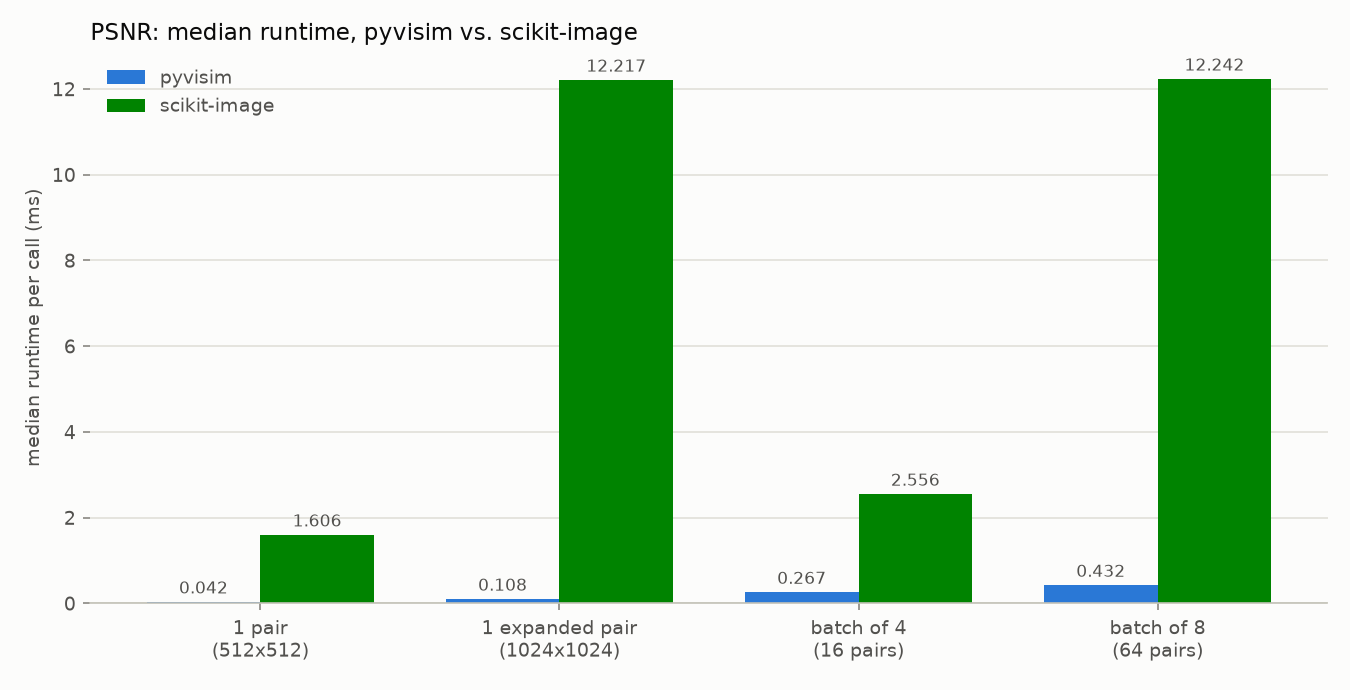
Median runtime per full scoring call (PSNR of every image in the first gallery against every image in the second).
Scenario |
Images |
pyvisim (ms) |
Baseline (ms) |
Speed-up |
|---|---|---|---|---|
1 pair (512x512), 512x512 |
|
0.043 |
1.444 |
33.6x |
1 expanded pair (1024x1024), 1024x1024 |
|
0.131 |
12.380 |
94.7x |
batch of 4 (16 pairs), 256x256 |
|
0.285 |
2.653 |
9.3x |
batch of 8 (64 pairs), 256x256 |
|
0.460 |
9.835 |
21.4x |
API reference
- class pyvisim.dense.pixelwise.PSNR(batch_size=16)[source]
Bases:
DenseMetricBasePeak signal-to-noise ratio between two batches of images.
The metric is computed pairwise: for
Nimages in the first batch andMimages in the second batch,similarity_score()returns an(N, M)matrix of PSNR values in decibels, where identical pairs yieldinf. Every compared pair must share the same(H, W[, C])shape.The squared differences are summed by a compiled OpenMP kernel. Set the
PYVISIM_NUM_THREADSenvironment variable to override the team size.For more information, see the documentation:
file:///home/critter_cool_laptop/workspace/Python-Visual-Similarity-parallel/docs/_build/html/pixelwise/psnr/psnr.html.- Parameters:
batch_size (int) – Maximum number of images processed in a single batch. Set to
-1to process all images as a single batch.- Raises:
ValueError – If
batch_sizeis neither-1nor a positive integer.
Example:
>>> import numpy as np
>>> from pyvisim.dense.pixelwise import PSNR
>>> image = np.random.default_rng(0).integers(0, 256, (32, 32, 3), dtype=np.uint8)
>>> PSNR().similarity_score(image, image)
array([[inf]])
- set_batch_size(batch_size)
Sets the number of items processed per batch.
- Parameters:
batch_size (int) – Maximum number of images processed in a single batch. Set to
-1to process all images as a single batch.- Raises:
ValueError – If
batch_sizeis neither-1nor a positive integer.- Return type:
None
- similarity_score(image1, image2, *, dims='HWC', value_range=(0.0, 255.0))
Compute the pairwise score matrix between two image batches.
Every image is normalized to the canonical
uint8(H, W[, C])layout in[0, 255]first, so the metric always operates on the same value scale regardless of the input dtype or range.- Parameters:
image1 (_Buffer | _SupportsArray[dtype[Any]] | _NestedSequence[_SupportsArray[dtype[Any]]] | bool | int | float | complex | str | bytes | _NestedSequence[bool | int | float | complex | str | bytes] | Iterable[_Buffer | _SupportsArray[dtype[Any]] | _NestedSequence[_SupportsArray[dtype[Any]]] | bool | int | float | complex | str | bytes | _NestedSequence[bool | int | float | complex | str | bytes]]) – First (batch of) image(s) as
MatLike(NumPy array, torch tensor or array-like).image2 (_Buffer | _SupportsArray[dtype[Any]] | _NestedSequence[_SupportsArray[dtype[Any]]] | bool | int | float | complex | str | bytes | _NestedSequence[bool | int | float | complex | str | bytes] | Iterable[_Buffer | _SupportsArray[dtype[Any]] | _NestedSequence[_SupportsArray[dtype[Any]]] | bool | int | float | complex | str | bytes | _NestedSequence[bool | int | float | complex | str | bytes]]) – Second (batch of) image(s) as
MatLike.dims (str) – Axis-label string, one character per array axis in order:
"H"= height (rows),"W"= width (columns),"C"= channels (e.g. RGB),"B"= batch size. For example,"HWC"is height × width × channels (NumPy/OpenCV single-image layout);"CHW"is channels × height × width (PyTorch single-image layout);"BCHW"is batch × channels × height × width (PyTorch batched layout). Seepyvisim.typing.value_range (tuple[float, float]) – The
(low, high)range the input values live in; converted into the canonical[0, 255]range.
- Returns:
A
(N, M)matrix scoring every image ofimage1against every image ofimage2.- Raises:
InvalidImageError – If an input cannot be converted to a numeric array.
ValueError – If a batch is empty, the two batches hold images of different shapes, or the images are too small for the metric.
- Return type: