K-Reciprocal Reranking
KReciprocalReranker re-orders the candidates a store retrieved for a query
with the k-reciprocal encoding of Zhong et al. [1]. Two images are
k-reciprocal neighbors when each is among the k1 nearest neighbors of the
other, a far stricter relation than merely being close to the query: a false
match may lie close to the query, but the query rarely lies close to the false
match’s own neighbors. The query and every candidate are encoded into a
k-reciprocal feature, a vector over the candidate set that holds a Gaussian
weight for each of their k-reciprocal neighbors and zero elsewhere, and the
Jaccard distance between the query’s feature and a candidate’s says how much
their neighborhoods agree. The candidates are finally re-ranked by
(1 - lambda_value) * jaccard + lambda_value * original, where original
is the distance the store ranked them by.
The candidates must come from the store that is passed to the reranker, and a
store on an ExternalSearchIndex is rejected. For more technical
information, visit
https://github.com/MechaCritter/Python-Visual-Similarity/blob/main/docs/image_similarity_retrieval/arc42.md.
Example
Tip
See this tutorial for a more detailed walkthrough.
from pyvisim.neural_networks import ClipEmbedder
from pyvisim.retrieval.image_store import InMemoryImageEmbeddingStore
from pyvisim.retrieval.reranking import KReciprocalReranker

store = InMemoryImageEmbeddingStore(gallery_paths, ClipEmbedder(), "hnsw")
store.build_store()
reranker = KReciprocalReranker(store, k1=20, k2=6, lambda_value=0.3)

# Retrieve a pool of candidates, then keep the best five after re-ranking
# Retrieve more candidates than you finally want with the `InMemoryImageEmbeddingStore`,
# at least `k1` and better a few dozen more than `top_k`.
candidates = store.retrieve_top_k_similar(query_image, k=100)[0]
best = reranker.rerank(candidates, top_k=5)
Reranking algorithm
Let the probe \(p\) be the query and \(\mathcal{G} = \{g_i \mid i = 1, 2, \dots, N\}\) are the candidates, so the set the neighborhoods are built over holds \(N + 1\) images.
Original distance. \(d(p, g_i)\) is the score the store ranked the candidate by, and \(d(g_i, g_j)\) is computed from the candidates’ embeddings in the store’s
space. Every row of it is divided by its largest entry (reference implementation), and hence lies in range \([0, 1]\).k-nearest neighbors, Eq. (2). The ranking list \(\mathcal{L}(p, \mathcal{G})\) sorts the set by \(d\), and \(N(p, k)\) is its top-\(k\):
\[N(p, k) = \{g_1^0, g_2^0, \dots, g_k^0\}, \quad |N(p, k)| = k\]The ranking list runs over the probe and the candidates together, the image itself at rank zero (reference implementation), and the same definition serves every candidate \(g_i\) in place of \(p\).
k-reciprocal neighbors, Eq. (3). Only the neighbors that hold \(p\) among their own \(k\) nearest neighbors are kept:
\[\mathcal{R}(p, k) = \{g_i \mid (g_i \in N(p, k)) \wedge (p \in N(g_i, k))\}\]Expansion, Eq. (4). With \(k = k_1\), every member \(q\) of \(\mathcal{R}(p, k)\) brings its own \(\tfrac{1}{2}k\)-reciprocal neighbors in, provided at least two thirds of them already lie in \(\mathcal{R}(p, k)\):
\[\mathcal{R}^*(p, k) \leftarrow \mathcal{R}(p, k) \cup \mathcal{R}(q, \tfrac{1}{2}k) \quad \text{s.t.} \quad |\mathcal{R}(p, k) \cap \mathcal{R}(q, \tfrac{1}{2}k)| \geq \tfrac{2}{3} |\mathcal{R}(q, \tfrac{1}{2}k)|, \quad \forall q \in \mathcal{R}(p, k)\]k-reciprocal feature, Eq. (7). Each image is encoded into a vector over the set, a Gaussian kernel of the original distance on its expanded neighborhood and zero elsewhere:
\[\begin{split}\mathcal{V}_{p, g_i} = \begin{cases} e^{-d(p, g_i)} & \text{if } g_i \in \mathcal{R}^*(p, k_1) \\ 0 & \text{otherwise} \end{cases}\end{split}\]Each vector is scaled to unit \(L_1\) norm (reference implementation), so the Jaccard distance below compares the shape of two neighborhoods rather than their size.
Local query expansion, Eq. (11). The feature of every image is replaced by the mean feature of its \(k_2\) nearest neighbors, the image itself included (reference implementation).
k2=1skips this step.\[\mathcal{V}_p = \frac{1}{|N(p, k_2)|} \sum_{g_i \in N(p, k_2)} \mathcal{V}_{g_i}\]Jaccard distance, Eq. (10). The overlap of two neighborhoods is read off their features with the element-wise minimum and maximum:
\[d_J(p, g_i) = 1 - \frac{\sum_{j=1}^{N} \min(\mathcal{V}_{p, g_j}, \mathcal{V}_{g_i, g_j})} {\sum_{j=1}^{N} \max(\mathcal{V}_{p, g_j}, \mathcal{V}_{g_i, g_j})}\]Final distance, Eq. (12). The Jaccard distance is mixed with the original one, and the candidates are sorted by it in ascending order.
rerankreturns the firsttop_kof them, each scored by its \(d^*\):\[d^*(p, g_i) = (1 - \lambda) \, d_J(p, g_i) + \lambda \, d(p, g_i)\]
Benchmark: Use the ClipEmbedder for retrieval on the Oxford Flower dataset
Important
The numbers in this section were produced by
scripts/benchmark_reranking.py. Do not edit this section manually.
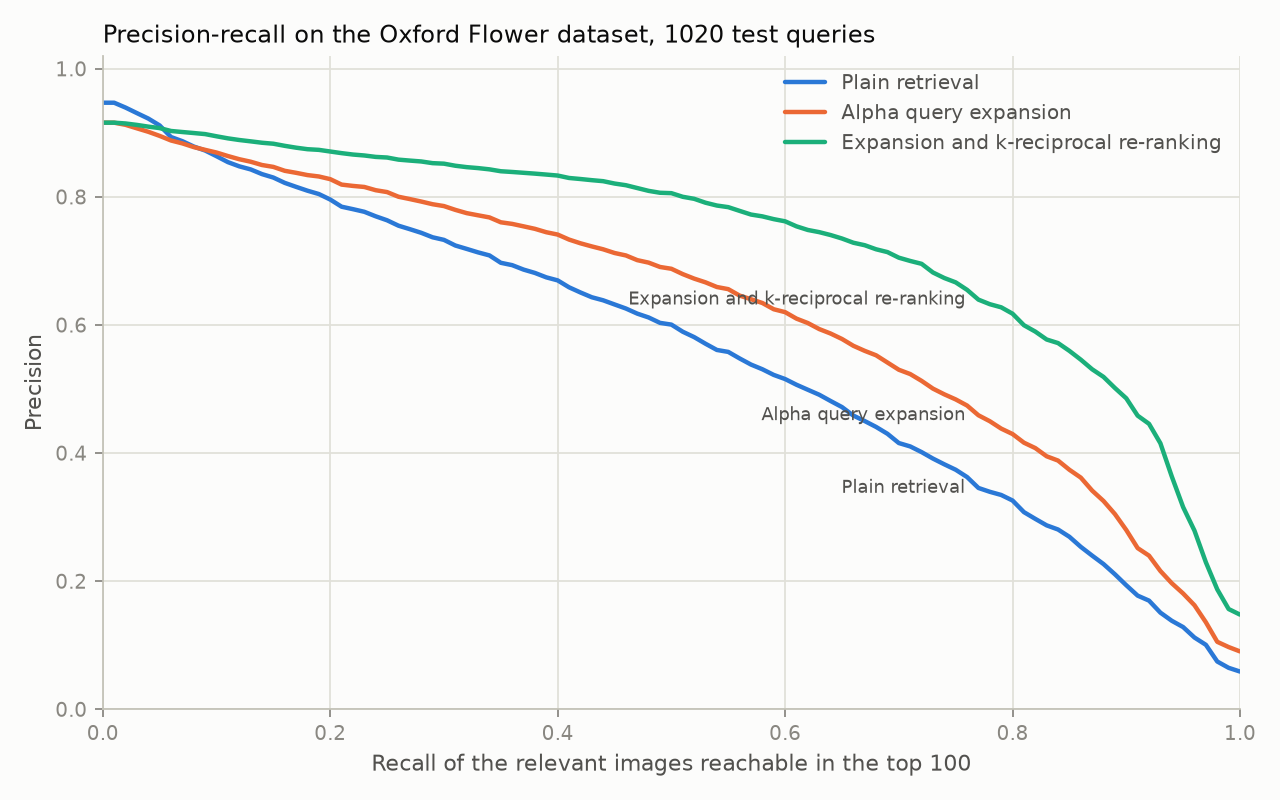
All 6149 images of the Oxford Flower dataset (train split) are embedded by
ClipEmbedder("ViT-B-32", "openai") into an InMemoryImageEmbeddingStore on the
hnsw index, and the 1020 images of the test split are the queries. A result is
relevant when it shows the query’s flower category. Every configuration returns the
top 100 results of a query: recall@k is the share of queries with a relevant image
among the first k results, mAP@100 the mean average precision over the top 100
(normalised by the relevant images a query can reach within them), and MRR the mean
reciprocal rank of the first relevant result. The hyperparameters were picked on the
validation split, and the re-ranking works on a pool of the top 200 candidates of
the expanded query. The time per query includes the embedding of the query image on
the GPU.
Configuration |
Recall@1 |
Recall@5 |
mAP@100 |
MRR |
Time per query |
|---|---|---|---|---|---|
Plain retrieval |
90.3% |
97.1% |
55.6% |
93.5% |
4.3 ms |
Alpha query expansion ( |
87.8% |
94.7% |
62.4% |
90.6% |
4.3 ms |
Alpha query expansion and k-reciprocal re-ranking ( |
88.8% |
91.8% |
73.1% |
90.5% |
18.7 ms |
The precision-recall curves interpolate the precision of every query at fixed recall levels (the best precision at that recall or beyond) and average it over the queries. The recall is relative to the relevant images a query can reach within the top 100.
References
[1] Z. Zhong, L. Zheng, D. Cao, and S. Li, “Re-ranking Person Re-identification with k-reciprocal Encoding,” in Proc. CVPR, pp. 1318-1327, 2017.
API reference
- class pyvisim.retrieval.reranking.KReciprocalReranker(store, *, k1=20, k2=6, lambda_value=0.3)[source]
Bases:
objectRe-rank retrieval candidates with k-reciprocal encoding.
For more information, see the documentation:
https://mechacritter.github.io/Python-Visual-Similarity/image_similarity_retrieval/reranking/k_reciprocal_reranker/k_reciprocal_reranker.html.- Parameters:
store (InMemoryImageEmbeddingStore) – The store the candidates were retrieved from.
k1 (int) – Size of the neighborhoods the k-reciprocal sets are built from. [1] uses
20.k2 (int) – Size of the neighborhood the local query expansion averages the k-reciprocal features over.
1turns the expansion off. [1] uses6.lambda_value (float) – Weight of the original distance in the final distance, from
0(Jaccard distance only) to1(original ranking kept). [1] uses0.3.
- Raises:
TypeError – If
storeis not anInMemoryImageEmbeddingStore.ValueError – If the store searches through an external index,
k1ork2is not a positive integer,k2exceedsk1, orlambda_valuelies outside[0, 1].
References:
- [1] Z. Zhong, L. Zheng, D. Cao, and S. Li, “Re-ranking Person
Re-identification with k-reciprocal Encoding,” in Proc. CVPR, pp. 1318-1327, 2017.
- rerank(candidates, top_k)[source]
Re-rank the candidates of one query and return the best
top_k.The candidates are the ranked matches of a single query, as one row of
retrieve_top_k_similar()returns them, and their scores are the query’s distances to them. The neighborhoods are built among the candidates themselves, so a pool no larger than the answer leaves them nothing to say: retrieve at leastk1candidates and a few dozen more thantop_k. Neighborhood sizes beyond the number of candidates are capped at it.- Parameters:
- Returns:
The
top_kbest candidates, best first, each scored by the final distance of Eq. (12) of [1], which lies in[0, 1]and is lower for a better match.- Raises:
ValueError – If
candidatesis empty, names a path twice or one the store does not hold, a score is not finite, ortop_kis not a positive integer.
- Return type:
- property store: InMemoryImageEmbeddingStore
The store the candidates are read back from.